

StemEdit OC-1 Protein
| QTY | Cat # | Size | Unit Price |
|---|---|---|---|
|
| 03-0020 | 130 ug | $600.00 |
* Prices listed are in USD. Taxes, shipping & handling not included. Contact us for bulk pricing.
Overview
Open-Source Genome Editing for Research
StemEdit OC-1 Protein is a recombinant, AI-designed genome-editing nuclease that provides a next-generation alternative to conventional Cas nucleases. StemEdit OC-1 Protein enables high editing efficiency with low off-target activity while helping researchers reduce intellectual property barriers.
Each vial provides 130 µg of StemEdit OC-1 Protein, suitable for 2-3 assays under typical conditions.
Why Choose StemEdit OC-1?
-
Open-Source Technology
Based on open-source OpenCRISPR-1™ (OC-1) technology, providing an alternative to conventional Cas nucleases. -
High Editing Efficiency
Robust genome editing performance across a wide range of cell types. -
Low Off-Target Activity
Designed for precise and reliable genome modification. -
AI-Designed Technology
Engineered using advanced AI-guided protein design for next-generation genome editing.
StemEdit OC-1 Protein was devised using large protein language models (LLMs) pre-trained on millions of naturally occurring CRISPR–Cas sequences to learn the underlying principles of functional genome editors. These models were then fine-tuned specifically on CRISPR–Cas data to guide generation toward proteins with the structural and functional characteristics of Cas9-like nucleases, creating novel gene editors far outside the range of sequences found in nature. OC-1 was identified from millions of sequences based on its strong editing activity, on-target efficiency comparable to traditional SpCas9, and reduced off-target effects in human cells, making it well-suited for genome engineering applications in stem cell and cell therapy research.
Typical experimental conditions
In a typical experiment using iPSCs and a guide RNA (gRNA) specific to the desired edit, an OC-1/gRNA ribonucleoprotein complex (RNP) was formed at a 2:1 to 4:1 mole ratio of gRNA to OC-1 protein, incubated for 10 min at room temperature, mixed with cell suspension (1 million cells in 100 uL suspension), and delivered to the cells using the Neon NxT Electroporation System (Thermo Fisher). Buffers provided in the Neon NxT kit were used to form the RNP and electroporate the cells. For iPSCs, we typically use 3-5 µL (40-65 µg, 0.24-0.4 nmol) of StemEdit OC-1 protein to form the RNP complex, with electroporation conditions of 1200 V, 20 ms, 2 pulses.
After electroporation, the cells are immediately transferred to an appropriate growth medium, and the resulting cells are screened after 48-72 hours of culture using a PCR-genotyping-based approach. The resulting sequencing data can be analyzed using the ICE Application (EditCo) to determine the editing efficiency.
Other methods that are commonly used with Cas nuclease-based gene editing systems for forming the RNP and delivering it to the cells will probably work with OC-1 Protein as well. Optimization of the RNP formation and delivery conditions may be required to determine conditions suitable for your gRNAs, cells, and RNP delivery system.
Find out about the science behind the OC-1 protein in our recent blog post.
Applications
- Knock-in of large gene fragments (e.g., reporters, regulatory elements)
- Knock-in of biallelic mutations for disease models or functional studies
- Knock-out of single or multiple genes
StemEdit OC-1 Protein is intended for Research Use Only. GMP StemEdit OC-1 Protein is also available for clinical-stage development projects involving gene editing.
For clinical therapeutic gene editing projects, please contact our (StemEdit) service team to learn more about our genome engineering capabilities.
See also:
-
StemEdit Gene Edited iPSCs — Our hypoimmune iPSCs
-
StemEdit Clinical Gene Editing Service — Our license-free editing services.
-
Clinical Stem Cell Services — Clinical-grade iPSC solutions.
-
StemRNA™ iPSCs — Research-grade iPSC collection.
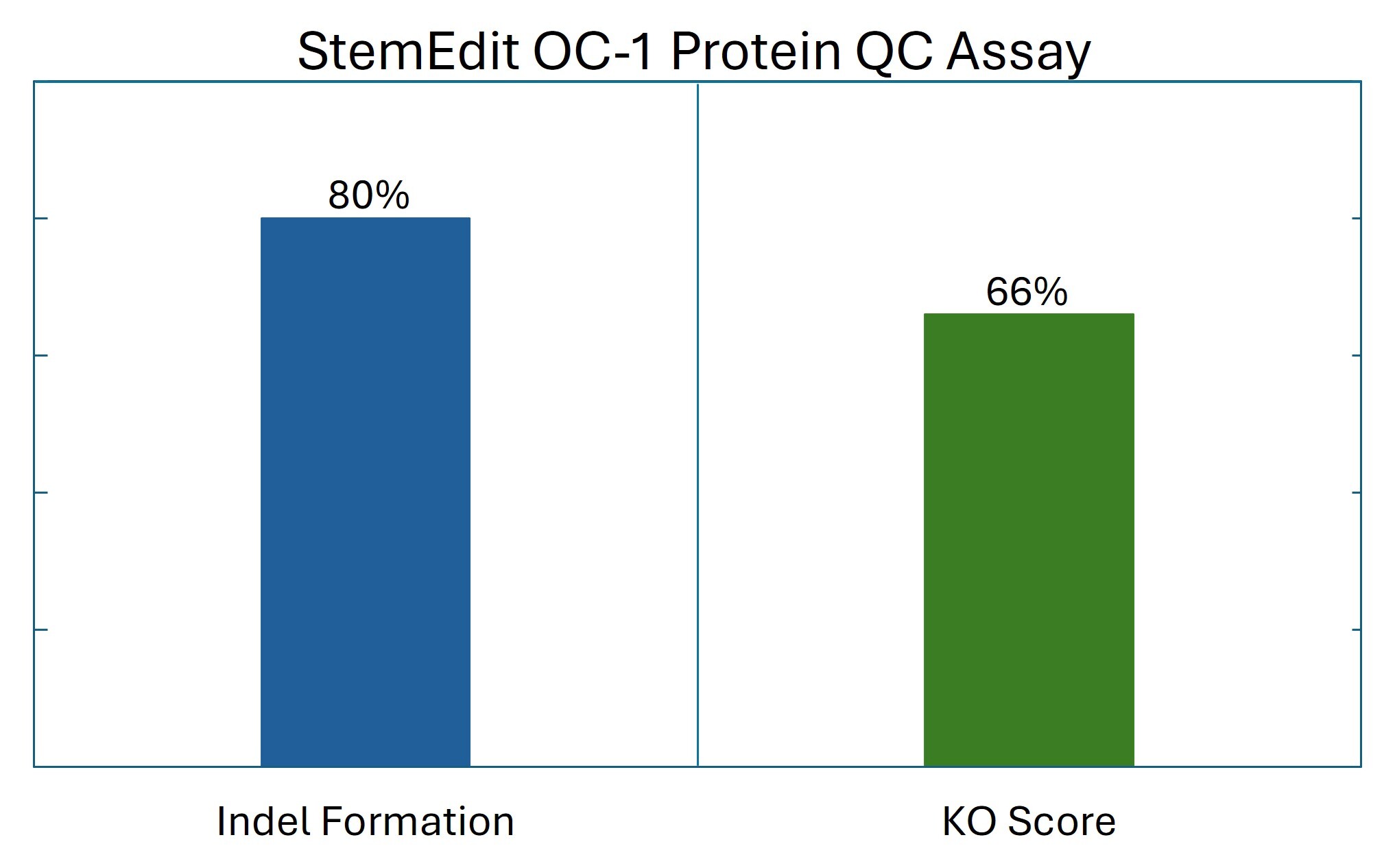
Figure. StemEdit OC-1 Protein was assayed for gene editing activity using a test guide RNA and a target cell, and the data were analyzed using the ICE App (https://ice.editco.bio/#/). This assay showed that this batch of OC-1 achieved 80% indel formation, demonstrating robust gene editing activity.
Stemgent and the StemEdit brand name are trademarks of REPROCELL Inc., Japan. OpenCRISPR-1 is a trademark of Profluent Bio, Inc.